Double Choco
Double Choco first appeared in Nikoli volume 163 (2018). The genre was invented by a reader using the alias “Airplane.” According to the creator, the inspiration partially came from fractal art, where similar patterns repeat at different scales — a concept that resonates with the puzzle’s requirement to form paired shapes.
In Double Choco, the grid must be divided into regions, each containing exactly two connected areas of equal size — one black and one white. The two areas within a region must be congruent (i.e., identical in shape), though they may be rotated or reflected depending on variant rules.
These constraints create a puzzle type that is both visual and structural, combining ideas from region division puzzles with symmetry-based reasoning.
The original Japanese name ダブルチョコ (daburu choko) literally means “Double Chocolate,” a playful reference to the black-and-white pairings inside each region.
Double Choco stands apart from typical dissection puzzles by its strong focus on paired geometry, making it one of Nikoli’s most distinctive modern puzzle types.
In Double Choco, the grid must be divided into regions, each containing exactly two connected areas of equal size — one black and one white. The two areas within a region must be congruent (i.e., identical in shape), though they may be rotated or reflected depending on variant rules.
These constraints create a puzzle type that is both visual and structural, combining ideas from region division puzzles with symmetry-based reasoning.
The original Japanese name ダブルチョコ (daburu choko) literally means “Double Chocolate,” a playful reference to the black-and-white pairings inside each region.
Double Choco stands apart from typical dissection puzzles by its strong focus on paired geometry, making it one of Nikoli’s most distinctive modern puzzle types.
Rules
Divide the grid along the grid lines into regions. Each region must contain one orthogonaly connected area of white cells and one area of shaded cells. The pair of areas must be of the same shape and size. The areas may be rotated or mirrored. A number indicates how many cells of one color the region contains. A region may contain several numbers - in this case all numbers must be equal.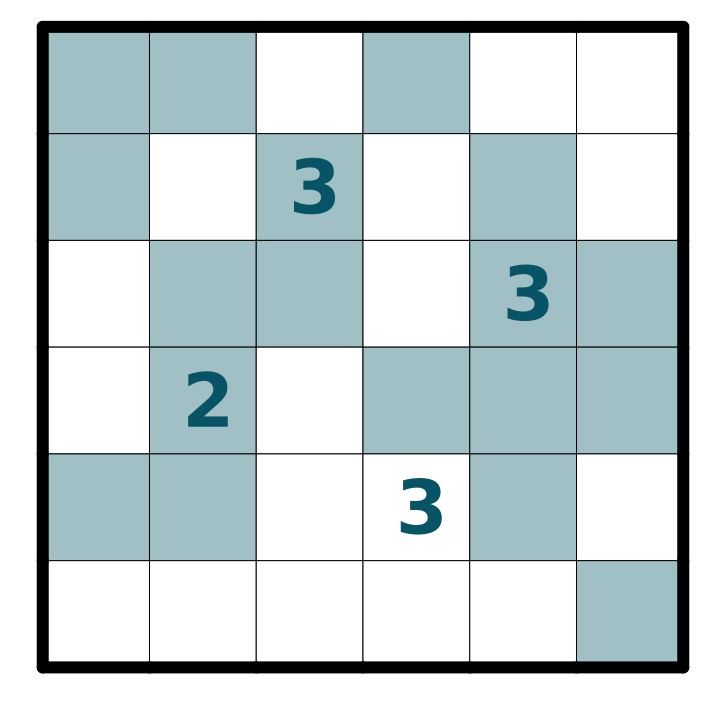
Click to see the answer.