Suguru
Suguru was invented by Naoki Inaba (Japan) in 2001, originally under the name ナンバーブロック (“Number Block”). The internationally used name “Suguru” was later introduced by Puzzler Media Ltd (UK) as a contraction of suji gurupu (“number group”), since they felt the original title did not sufficiently describe the nature of the puzzle.
In Suguru, the grid is divided into irregular regions (or “blocks”). Each region must contain the numbers 1 to n, where n is the size of that region. Additionally, no two orthogonally or diagonally adjacent cells may contain the same number.
These simple rules create elegant and surprisingly deep logic, combining local deductions with interactions across neighboring regions.
Over time, Suguru has been known by several alternative names — including Number Blocks, Zahlenblöcke, and Capsules — but Suguru has become the dominant international term. The puzzle has appeared in the World Puzzle Championship since 2014 and is now a widely recognized and popular genre.
In Suguru, the grid is divided into irregular regions (or “blocks”). Each region must contain the numbers 1 to n, where n is the size of that region. Additionally, no two orthogonally or diagonally adjacent cells may contain the same number.
These simple rules create elegant and surprisingly deep logic, combining local deductions with interactions across neighboring regions.
Over time, Suguru has been known by several alternative names — including Number Blocks, Zahlenblöcke, and Capsules — but Suguru has become the dominant international term. The puzzle has appeared in the World Puzzle Championship since 2014 and is now a widely recognized and popular genre.
Rules
Fill in all cells of the grid with numbers. Every outlined area must contain the consecutive integers from 1 to the number of cells in that area. Cells sharing edge or vertex shouldn't contain identical numbers.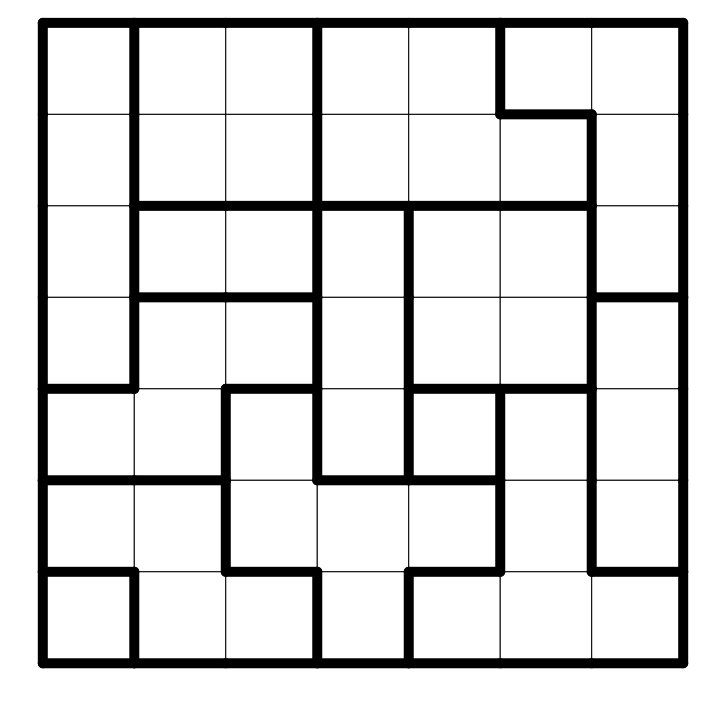
Click to see the answer.